Sunday, November 24, 2013

Church 101: A Seeker's Guide


Maybe you've never been to church before except for weddings and funerals, or maybe you used to go a long time ago but haven't gone lately. For whatever reason, you want to give church a try. This guide is for you. I've been there myself--I stopped going to church when I was fifteen years old and returned to churchgoing at age twenty-one. In the intervening years I tried going to a few different churches but they turned me off. Finally, after talking to a friend who enjoyed her experiences at church and reading a book by a feminist nun, I decided to give church another try. This time it "took." Eventually I studied theology and became a Pastor. I still think of myself as an ex-ex-Christian, and I have a lot of compassion for people who are not part of a church community. I've been there. Your gripes are based in reality. And yet...church still exerts a pull. This guide is for people like that, people who want to give church a try. I'll try and put my pointers in order of importance, but honestly everyone is different so you might see it differently from me. I am a Protestant and was raised as a member of a Protestant church, but during my own time of seeking I attended a Roman Catholic church. In addition, as part of my education I have attended services in a variety of traditions, including Orthodox churches. This advice applies to church seekers across all traditions.

  • Ask God to help you find a church. Maybe you have never prayed and aren't even sure that there is a God you can believe in. It doesn't matter. In your own way and in your own words, ask whoever or whatever is out there in the Universe that cares about you to help point you in the right direction.
  • Avoid churches that seem to have all the answers and are convinced that they are right and others are damned. Churches in America have a wide variety of viewpoints about what they consider moral behavior. Just because the members of a particular church seem thoroughly convinced that they are right and everyone who disagrees with them is wrong does not make it true. The certainty may seem appealing to you in a time of uncertainty in your own life, but what you need at times like that is not certainty. You need someone to hold your hand while you slowly and gradually find your own way.
  • Understand that not every church is right for every person. There is a very wide variety among churches--what they value, and how they practice Christianity. Somewhere in that mix you will probably find the right church for you. 
  • The easiest way to find a good match is to talk to a friends who participate in church. Try to avoid approaching friends who seem very interested in recruiting more members to their particular church. These friends, while well-meaning, may not be objective enough to help you, and it may strain the friendship if you try their church and find it not to your liking. 
  • If you don't have friends who go to church, you can try checking out church websites, but be warned: church websites can be outdated and misleading. Some of them are great at providing accurate information that is useful to seekers like yourself. Others, not so much, but they may be a perfectly good church once you get there. If anything attracts you--even if it's just the photo of the building--don't be afraid to check it out.
  • Bring a friend. If you aren't able to go to a church where you know anyone, and you aren't one of those super-friendly, confident, take-charge types, ask someone to go with you. Ideally it should be someone who is not rabidly anti-religious, but a person with no particular interest in joining a church might be a great choice. You can talk about your experience afterwards and their objective opinions might prove useful. One thing to be aware of is that if you are a single woman (or a woman who plans to attend church by yourself) and you bring a friend of the male persuasion, you may be treated differently if you return alone. I don't know why this is but I have experienced it myself. Some churches are less friendly to women alone than others, and if that applies to you, you're going to want to know that. Maybe you could have your friend park the car while you enter alone and then join you within a minute or so. This problem may also apply to men alone, but I wouldn't personally know that. I don't doubt that others experience a sense of not being welcome in some churches just because of who they are. 
  • If you don't feel welcome and in some sense "at home" from the moment you open the door and cross the threshold, this church is not for you. Why is this? I don't know, but experience has taught me that this is the case. Churches have a "vibe." It's mystical, and it's real. Some churches even feel super welcoming when you drive past. Those are probably good bets for you to check out.
  • If a church seems very unwelcoming or even rejecting of you, don't ever feel that God is rejecting you. Some people feel that churches speak for God. You don't need a church to find God. God is accessible to everyone 24/7. You find God inside you. Church is there to help you find God and to make the most of your relationship with God. They aren't there to talk down to you on God's behalf.
  • Be prepared to "dump" a church. Some churches seem great at first but turn out to be really wrong for you--incompatible with your personal value system, or just creepy-seeming. Sometimes individual members in a church may behave in a way that makes you very uncomfortable. Don't hesitate to leave. Churches are human institutions. None of them are perfect. Some of them are very far from perfect.
  • Don't feel guilty about letting go of a perfectly nice church where you don't feel quite at home and resuming your search. Some churches are welcoming to you but will not meet your needs. Trust your gut, not just your head. Don't rationalize too much or overthink it. 
  • There are no perfect churches, but there are churches that are perfect for you. It's like romance--when you have the right chemistry it is possible to live with flaws.
  • Churches have unwritten rules. Sometimes the unwritten rules contradict the written rules. This can cut both ways--it can be a good thing or a bad thing. In this way they are like any other organization--like your job, or the family you married into. Sometimes people may seem upset at you for reasons that have you mystified. The most likely explanation is that you have unwittingly violated an unwritten rule. You can just ask (but maybe not ask that person. Use your judgment. Ask a friend at the church or the Pastor if the person has intimidated you.) You will need to accept a little bit of a learning curve of unwritten rules. You also need to develop some self-awareness about how much of that sort of thing is acceptable to you. You may even find the actual unwritten rules to be offensive. In that case, your choice is to stay and try to change the culture, or leave. Maybe I will cover strategies for changing church culture  in a different blog post. The bottom line is, protect your heart and your dignity. Don't be afraid to speak up for yourself, but if you feel continually trampled on and your feelings ignored, maybe this isn't the right church for you. Church is like love--it's not supposed to hurt.
  • If you think you've found the church that is right for you, join a group. The best way to make friends and have the experience you are looking for at a church is to find a group that does something you enjoy doing and join it. If you like to sing, joining the choir is the best way to make friends, have fun and learn about the church. If you don't like to sing there are still other great options. Often the committees that handle finances or building maintenance have trouble finding members with skills in those areas, so if you like working with that, ask a friend at the church or the pastor how to get involved in those areas. If you love children and teaching, the Sunday School program is often looking for volunteers. Beyond that, most churches have fundraisers or charitable volunteering opportunities, and if you volunteer for those things you will get to know people. Churches also are often looking for people who like to bake things for coffee hour, to donate flower arrangements, and to visit elderly people. If you have an interest in any of those things, you will find it easy to become involved in a church. However, if you have other skills and interests, it can become tricky to find a niche in a some churches--especially if you aren't all that familiar with church culture (those pesky unwritten rules!) Your best option at most churches is a spiritually-oriented group, such as Bible Study or a prayer group. Some churches also have groups that are organized around life stages (such as a singles group or a couples group.) Though the members of a particular group may seem very different from you in terms of age and stage of life, my advice is to give them a chance. (You don't have to go more than once if it's an uncomfortable experience, of course.) You may find that a group of women in their eighties who gather to pray each week may make lovely companions for a person in their 20s. 
  • Start a group--if you are the kind of person who likes starting things and if the church culture makes that easy. Some churches are open to people starting things. Ask the Pastor or a friend at church how to go about starting something new.

I hope this guide is helpful to someone. People seek to join churches for deeply personal but important reasons. Churches should do a better job of recognizing this fact and do better at reaching out to assist folks that would love to meet them and join their congregation. Until that happens, maybe this guide will help bridge the gap.


Saturday, November 23, 2013

Unplug the Christmas Machine!

 
I can't believe the time for my annual Jeremiad about the commercialization of Christmas is here again.
Stores are opening for Christmas shopping ON THANKSGIVING DAY?


I've taught a workshop called "Unplug the Christmas Machine" (based on a book of the same name, plus other materials such as Hundred Dollar Holiday and To Dance with God) about a dozen times The focus of the book is on putting more love and joy into the holiday. I add some ideas about saving money and making the holiday more spiritual.
The heart of Unplugging the Christmas Machine is the Christmas Pledge, which people are asked to sign and post in their home:

The Christmas Pledge

Believing in the true spirit of Christmas, I commit myself to... 
* Remember those people who truly need my gifts 
* Express my love in more direct ways than gifts 
* Examine my holiday activities in the light of my deepest values 
* Be a peacemaker within my circle of family and friends 
* Rededicate myself to my spiritual growth

 (Find a leader's guide for an Unplug the Christmas Machine workshop here.) The thing is, I loooove the Advent-Christmas-Epiphany season. I love observing both religious and family-oriented traditions, holiday baking, Christmas music and decorating for the season. 
One of our holiday traditions--an Advent calendar of new socks for the children. Each sock contains candy for each child.

Another great Advent tradition is The Jesse Tree. For each day there is an ornament and a Bible story that starts with the Creation story and leads to the Christmas story. Find instructions, and a link to downloadable ornaments that kids can color and make themselves, here.
Little ones love coloring these.

With a little imagination it's easy to bring spirituality into your home. Here is a simple Advent wreath. 
Almost everyone could create this or something similar. Find a devotional guide here.

I enjoy natural decorations both inside and outside my home. Here are directions for making your own evergreen garlands. I use yard clippings and discarded/pruned branches from the Christmas tree.

I also like decorating with cranberries and other edibles.


These decorations are beautiful, inexpensive and earth-friendly, and in some cases even edible, which makes them even more affordable.

I hope you find these ideas inspiring. If you use any of them I would love to hear about it.

Monday, November 11, 2013

Feasting

On this mountain the Lord of hosts will make for all peoples a feast of rich food, a feast of well-aged wines, of rich food filled with marrow, of well-aged wines strained clear.-Isaiah 25:6


Judaism is a religion that is mainly observed around a table. Between weekly celebrations of Sabbath meals and observances holidays such as Rosh Hoshanna, Passover and Purim, Jewish families who pray together also eat together. I've been privileged to be a guest at some of these celebrations, and I've enjoyed every moment and every bite. 

Christians also have a tradition of feasting. Our most commonly observed sacrament, communion, originated as part of a Passover feast. Often when we celebrate this sacrament in a church, the Pastor says, "let us keep the feast." Then everyone shares a tiny wafer or morsel of bread and a sip of wine. It has become a symbolic and spiritual feast, a ritual re-enactment of a feast, rather than a feast in the traditional sense of eating heartily of rich foods. After worship, at most churches, the Worshippers head to a fellowship room and then the real feasting begins--coffee, cookies, donuts, muffins, sometimes even cheese and crackers. 

How did this happen? I'm not entirely sure. Some of my seminary professors bemoaned this fact, but none of them went into a detailed accounting of the history. There is some interest in recovering the tradition of eating as part of worship. (For a wonderful introduction to this, check out Feasting with God by Holly Whitcomb. I have road-tested a number of the feasts and recipes in the book with a variety of groups from ages 6 and up with great success.) And churches and Christians do tend to eat together quite often. Everyone who has been part of a church probably has a copy of a well-thumbed church cookbook (or two or three or ten) and a lot of happy memories of breaking bread together in the church building. My own tradition, the United Church of Christ, traces our roots back to the Pilgrims who originated the celebration of Thanksgiving. Thanksgiving is one of my favorite holidays, in part because of its spiritual roots and in part because it is pretty much impossible to commercialize it to a great extent. It saddens me to see retailers opening stores on Thanksgiving. I like the idea that since the 1930s most Americans have been able to take advantage of the national holiday status of the day to sit down to a meal with the people who mean the most to them,  and retail outlets are starting to erode that. It also makes me sad that they are doing it because people are actually interesting in shopping on Thanksgiving day.  I don't like to be one of those old people who clucks about the erosion of traditional values that made our country great, but, gee whiz, we're talking about Thanksgiving here. It doesn't get more traditional and American than Thanksgiving.

It is possible, of course, to celebrate a feast on any day of the year, and most people who can't share a feast on Thanksgiving Day find a way to celebrate the holiday on another day. And that's a good thing. Feasting helps build bonds of fellowship and love, whether it happens in a church, around a table or anywhere else.


Tuesday, November 5, 2013

Church, or Christian Club?


I'm in the process of applying for a church pastor position. Some of the available positions are, um, interesting. For example, for "number of members," one lists "20." For salary range, it says merely, "negotiable." In other words, will you let us pay you in garden vegetables and eggs?

Now, there are new churches of that size that are bound to grow. And there are old churches of that size that somehow also manage to grow. But for the most part, tiny churches that used to be much bigger have become, in actuality, Christian clubs rather than churches.

What is the difference? The role of the church is to be the Body of Christ in a suffering world. They seek to bring healing to the sick and Good News to the sick of heart. They provide a (partial, imperfect) experience of the not-yet-fully-realized Kingdom of God. While one individual congregation cannot serve the needs of all Christians, a church is able to meet the spiritual needs of a fairly wide variety of people. For this reason, a church needs a pretty high degree of openness.  A club, in contrast, need not be open at all. They can add members as their leadership and/or the totality of the members see fit, or not at all. Within the limits of the law they can erect barriers to membership, such as secrecy or hazing rituals. Many Christian clubs are wonderful, and do a lot of good for their members and other people. There is nothing wrong with being a Christian club--unless, of course, you are advertising your club as a church. Then you are engaging in deception. It may be born of self-deception, but it is deception, nonetheless.

Many of these clubby little groups that meet on Sunday morning in a building with a spire on top use words like "friendly" and "loving" to describe themselves, and they can be both of these things, but--let's be real--they most certainly are either not uniformly friendly and loving or at the very least have a checkered past in that regard.  They may think of themselves as welcoming, but they are not. In fact, most if not all of them are exceptionally good at being unwelcoming.

Is there hope for Pseudo-churches who want to change from being a Christian club back into a real church? Yes, but not without acknowledgement of the real situation. Why does it even matter? Because sometimes--often--someone really needs a church, and if that person tries to go to a church and finds out it really isn't a church, well, that's just really awful.


Wednesday, October 23, 2013

Prayers made visible

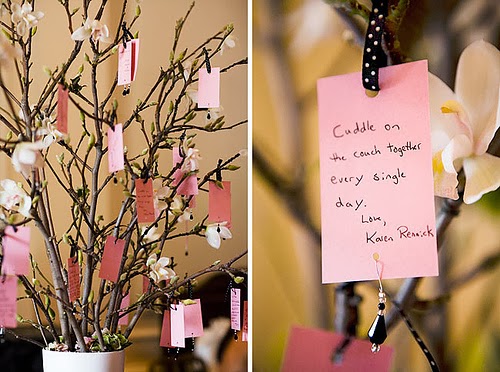
My Prayer Tree
One thing I've noticed about prayer is that I often promise to pray for the concerns of others, but sometimes I forgot. This wasn't always the case. Sometimes a prayer concern touches my heart and I keep returning to it over and over, but I couldn't find a pattern in my prayer behavior.  I wanted to stop being erratic about my prayers. In the excellent "Unbinding the Gospel" series of books I learned about creating a prayer wall, and I put a simple one together at my church using an old painted board and some post-it notes.

Image from http://eugenecho.com/2009/06/04/post-it-note-prayers/

The wall helped our congregation become more intentional about prayers, but because we turned down the heat when we were not using the building, the post-its sometimes fell. Then I remembered the wishing tree I had seen at a wedding. Guests were invited to attach written wishes to branches of a "tree"  (branches anchored in a pot by stones.)

Wouldn't a prayer tree work just as well? I did some searching and discovered that prayer trees existed. I wanted to adapt the idea for my home, so I secured a branch above a china cabinet.

To carry out my vision I needed to create the prayer cards. I wanted mine to be shaped like things you find in a tree--flowers, leaves and birds. I found clip art shapes and sized it large enough to write prayers.


Next, I created double-sided paper by gluing colorful scrapbook paper back-to-back. 

I tried a variety of methods for gluing the paper back to back. Spray adhesive worked the best by far.


Spray adhesive is found in art stores, craft stores and craft sections of discount stores. Be sure you read the directions before using it. It is very difficult to control the spray and difficult to clean up stray sprays. Spray in a well-ventilated area and protect the surfaces with newspaper or waxed paper.  I usually take the project outside if weather permits.

I like my leaves to have 2 different designs on them but you can match the papers however you like. Working quickly, spray the back of one page of colored paper and then place the back of the other on top of it.


When you are finished trace and cut your desired shapes from it. I then punch a hole and add a yarn or ribbon tie.
The completed leaf is ready for a prayer.


While I enjoy the free-form look of the prayer tree, the shapes could also be fashioned into a garland or tied to a wreath.

Feel free to send prayer requests my way...

Thursday, October 10, 2013

Blooming where you are planted


Build houses and live in them; plant gardens and eat what they produce. Take wives and have sons and daughters; take wives for your sons, and give your daughters in marriage, that they may bear sons and daughters; multiply there, and do not decrease.  But seek the welfare of the city where I have sent you into exile, and pray to the LORD on its behalf, for in its welfare you will find your welfare. Jeremiah 29:5-7

We think of Jeremiah as an angry, or at least pretty intense, prophet. The word "Jeremiad," meaning, you know, more or less, an intense rant, is even named after him. And then we get this:

Build houses and live in them; plant gardens and eat what they produce.  Take wives and have sons and daughters...

Jeremiah! Is this really you? What happened? Did you write this, like, right after you just fell in love with your wife or something?  You seem so--serene, I guess is the word I want here.

I mean, don't get me wrong--this seems like the right advice at the right time. And you do preface it by saying it is coming straight from the Lord, so I guess the Lord is pretty multi-faceted. 

I guess I should explain what this is about. It is pretty good general advice about how to have a contented life, but the actual context is the Babylonian exile, specifically the third Babylonian exile, during which people from Jerusalem have been displaced to Babylonia (which is mostly modern-day Iraq) after the total destruction of the city. God advises the people to,

...seek the welfare of the city where I have sent you into exile, and pray to the LORD on its behalf, for in its welfare you will find your welfare.

This does seem kind of weird coming from you, Jeremiah, if it is true, as legend has it, that you also wrote Psalm 137, which has this to say about the same Babylonian exile:

O daughter Babylon, you devastator! Happy shall they be who pay you back what you have done to us!  Happy shall they be who take your little ones and dash them against the rock!

I guess you and God are having different emotional reactions to the whole destruction of Jerusalem and subsequent exile from it. At least it isn't affecting your working relationship at all. Or maybe being so spiritual and so close to God for so many years is enabling you to be a less angry prophet. 

But this is good advice--let go of the hurt and anger and desire for revenge. It's kind of a spooky coincidence that this is the reading that comes up this week, the week that Elizabeth Smart's biography is released. Elizabeth Smart knows a thing or two about suffering. She was kidnapped by a crazy guy and his wife for nine months, and tortured every day. She even almost starved to death at one point. In spite of all that she went through, today Elizabeth is fine, thanks to advice her mother gave her.

 "Elizabeth, what this man has done to you is terrible. He has stolen nine months of your life that you will never get back.  But the best punishment you could ever give him is to be happy.”


This may be the motivation behind the advice that Jeremiah gives to the displaced in Babylon. It is possible to heal and move on, but it isn't easy. Sometimes the healing takes more than just one generation. Whatever it takes, healing is a worthy goal, and it can't be accomplished by sabotaging the place where you make your home. Wherever you are, God seems to be saying, and no matter how you came to be there, seek to bring something good and useful to that situation. That's just good old-fashioned solid advice. It was good advice almost three thousand years ago, and it's good advice today.


Monday, September 2, 2013

Stone Soup of Sin


So all the people took off the gold rings from their ears, and brought them to Aaron. 4He took the gold from them, formed it in a mold, and cast an image of a calf; and they said, “These are your gods, O Israel, who brought you up out of the land of Egypt!”  Exodus 32:3-4 (read the rest of the story here)

One of the first stories I remember from childhood is "Stone Soup." It's a folk tale about a traveler coming through a town and tricking the townspeople into providing him with food. At first he knocks on doors and asks for food, but the townspeople refuse to give him food and ridicule them. After a few rejections he builds a fire in the center of town and places a large pot of water on it. Then he adds a stone. He stirs the pot of water and periodically tastes it. The townspeople are intrigued by this behavior and ask him what in the world he is doing, and he tells them he is making stone soup. He then suggests that while plain stone soup is delicious, they can make it even better by adding other ingredients. The townspeople proceed to bring out the food that they had previously refused to share with the stranger, he adds it to the pot, and presto-- soon they all have soup to share.

The story of Aaron, Moses' brother, making a golden calf for the Israelites to worship is kind of a messed-up prototype for the stone soup story. The Israelites are none to happy with God for dragging them out into the desert and leaving them there with seemingly no end in sight. Often they have no idea where their next meal or drink of water will come from. In Egypt they were slaves, but at least they had the proverbial three hots and a cot. It seems as though they have gone from the frying pan to the fire. They are understandably mad at this God, and at his messenger, Moses, so when Moses goes up to the mountaintop to have a long heart-to-heart with God, his brother Aaron decides to take advantage of the Israelites in their weakened state and attempts to seize control by creating a false god for which he, not his brother Moses, will be the messenger. He takes the Israelite's jewelry, which is valuable but pretty much useless there in the desert, and uses it not to create delicious soup but false hope. 

People today sometimes fall into the trap that the Israelites fell into.  It is true that we don't pool our resources and intellect to create golden statues to worship, but too often when people work together it is not to do good but to do harm. This week is the week that most of the children in my state start school, so this passage of scripture makes me think of bullying. Being in school makes most kids feel vulnerable, so some of them try to get on top of the situation by participating in bullying. It is a way to fit in and belong and feel the safety and comfort of being part of a group working together, but wouldn't it be better if schools figured out how to harbor that desire of people to belong to a group and work together to create something rather than to tear down other kids?

This kind of working together to do something destructive doesn't just happen in schools and among children. It happens in families and in churches and in workplaces and in just about every human institution there is. Rooting it out can be difficult. A few verses after this, God suggests that the only way to truly stop it is to destroy the perpetrators. Moses refuses to participate in this. These are his people and he loves them. God loves them as well, but it is a tough love kind of love, and God knows that it will take a couple of generations to get them back on track spiritually and morally, and so because of this incident God forces the Israelites to continue to live in the wilderness for forty years, or two full generations. It is the grandchildren of the people who escaped Egypt who will get to experience the fullness of God's grace and love and mercy by moving into the so-called Promised Land, a land "flowing with milk and honey." 

We don't like the idea that our sins and shortcomings might reverberate through our lives into the future the way the Israelite's poor choices do, but once we accept this, we can begin to make better choices for ourselves and our own lives.

The implication of thinking through the impact of our choices, good and bad, on future generations is pretty profound and far-reaching. For example, there is a wide scientific consensus that we are going through many natural resources in a way that will deplete them. One little-known but widespread example of this is overfishing. Our appetite for certain fish could make them unavailable within a generation or two or even sooner in some cases. The solution is to fish more carefully, but that would require some international cooperation, and thus far that cooperation has just not happened. 

The bottom line is this: no person is an island. Our choices, for good or ill, impact other people, whether we want them to or not.